The Consumer Duty is a set of Financial Conduct Authority (FCA) rules that your pet insurer must follow. It has applied to policies on sale since 31 July 2023. Older, closed policies followed on 31 July 2024.
In short, your insurer must sell you cover that suits you, at a fair price. It must explain the policy clearly and help you when you need it.
The Duty does not set prices. It does not force your insurer to cover pre-existing conditions either. What it changes is the standard your insurer is judged against when something goes wrong. That makes your complaint easier to argue.
This guide explains what the Duty means for you, what the FCA’s own data shows about pet insurance and how to use your rights. We checked each rule on the FCA, Financial Ombudsman Service and GOV.UK websites on 16 October 2026.
What The FCA Consumer Duty Means For UK Pet Owners
The Consumer Duty means your insurer must be able to show two things: that your policy works for people like you, and that it gives fair value. The FCA brought it in through its policy statement PS22/9. It covers every retail financial product, so it covers your pet insurance.
The Duty is about outcomes. Your insurer cannot point to the small print and stop there. It has to check what you actually experience, from buying a policy to making a claim. Then it has to fix the problems it finds.
The Four Core Outcomes Of The Consumer Duty
The FCA sets out four outcomes that every firm must deliver, according to its Consumer Duty guidance. For a pet insurer, they work like this:
Products and services: the policy should suit the pets and owners it is sold to.
Price and value: the price should be reasonable compared with the overall benefits.
Consumer understanding: limits, excesses and exclusions should be explained so you can follow them.
Consumer support: help with claims, changes and cancellations should be easy to get.
You can point to each outcome in a complaint. If nobody explained a key exclusion to you, that is a consumer understanding issue. If your claim stalls for weeks without updates, that is a consumer support issue.
How Fair Value Assessments Affect Pet Insurance Premiums
Fair value means the price you pay is reasonable for what you get. The FCA says it does not set prices. A higher price can still be fair if your cover is better.
The reverse also holds. A policy with little real benefit is unlikely to be fair value at any price.
The FCA checks this with its general insurance value measures data. One measure is how much of the premium comes back to customers as claims.
In 2025, that share was 63% for lifetime pet policies, 51% for time-limited policies and 38% for maximum benefit policies, according to the FCA’s 2025 data.
Share of pet insurance premiums paid out in claims (FCA value measures data)
Policy type
2024
2025
Lifetime (covered for life)
57.7%
63%
Time-limited
48.9%
51%
Maximum benefit
Not shown in the FCA summary
38%
The FCA uses this data to spot products where you may not be getting fair value. Insurers with outlier results can expect closer checks.
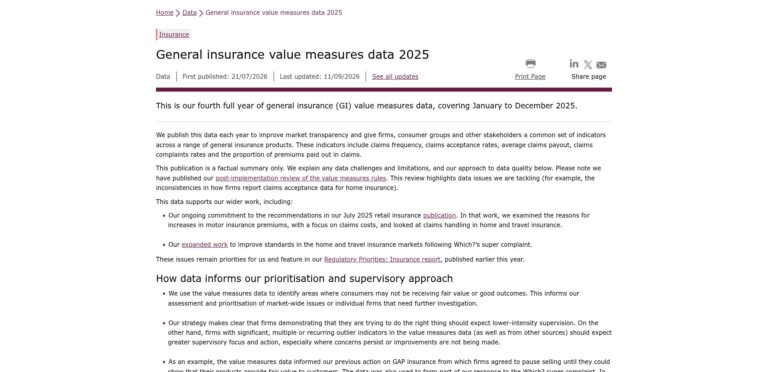
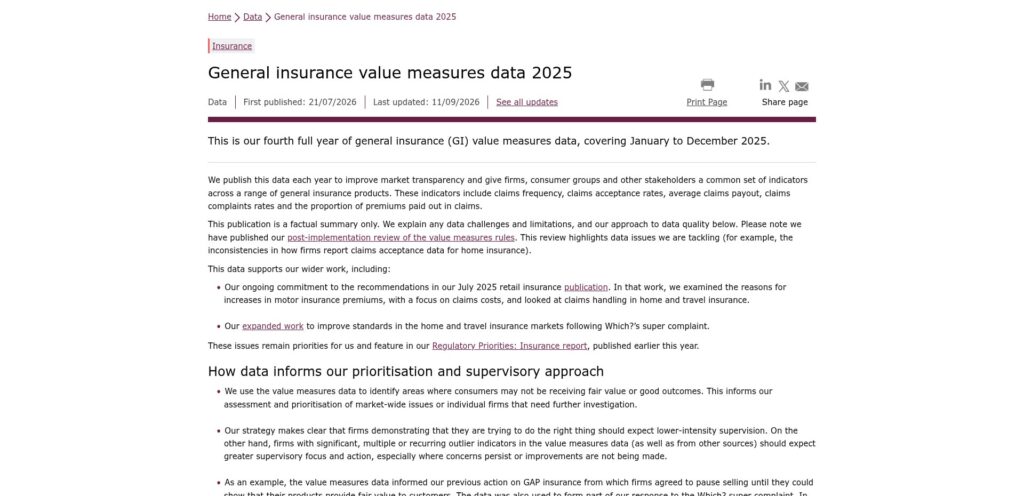
The FCA’s general insurance value measures data for 2025, published in July 2026. Screenshot: PetCoverHQ, 16 October 2026. Source: fca.org.uk.
Key Changes In Pet Insurance Policies Since 2025
Since 2025, the bigger changes have come in data and dispute rules, not in your policy wording. The FCA now has four full years of value data. The ombudsman has raised its award limit. And the Competition and Markets Authority (CMA) has ordered vets to change how they set out prices.
Improved Transparency And Plain English Policy Documents
Your insurer must explain the parts of your policy that matter most. That is the consumer understanding outcome. The Financial Ombudsman Service (FOS) says pre-existing condition rules should be mentioned when you buy and in the Insurance Product Information Document (IPID). Telling you to read the policy document is not enough.
The same goes for your excess and any co-payment. If these were not made clear when you bought or renewed, the FOS may decide it is unfair to apply them.
On a lifetime policy, the FOS also expects your insurer to warn you that prices can rise sharply as your pet gets older. Ask for that in writing if you are unsure.
Fairer Claims Handling And Reduced Waiting Times
Claims rules sit alongside the Duty. Under the FCA’s ICOBS 8.1, your insurer must handle your claim promptly and fairly. It must give you reasonable guidance and updates. It must not unreasonably reject your claim.
The consumer support outcome adds another test. Your insurer must not put unreasonable barriers in your way when you claim or cancel.
No published rule sets a number of days for paying a pet claim. If yours is delayed without explanation, you can include that in a complaint.
The Link Between The CMA Veterinary Probe And Pet Insurance Prices
Vet fees drive most pet insurance claims, so the CMA’s investigation into vets affects what you pay. The CMA found that average vet prices rose by 63% between 2016 and 2023, well above inflation. It published its final decision on 24 March 2026.
The CMA’s order was made in September 2026, and its measures arrive over the next year. Large vet groups must publish standard price lists from December 2026. Smaller practices follow in March 2027.
From June 2027, large groups must give you a written estimate for treatment expected to cost £500 or more. Smaller practices follow in September 2027. Written prescription fees will be capped at £21.40 for the first medicine and £12.70 for each extra one, from March 2027 at large groups, according to GOV.UK.
Impact Of Corporate Consolidation On Claim Costs
Large vet groups own many UK practices, and you may not know if yours is one. The CMA found that fewer than half of people using a large group knew their practice was part of a chain.
In its provisional findings, prices at large groups were 16.6% higher on average than at independent vets.
Under the order, your practice must show who owns it, on signs, at the premises and online. That helps you compare prices before a bill reaches your insurer.
Lower vet prices will not automatically cut your premium. That depends on each insurer’s fair value assessment. Our guide to how much vets charge covers current prices.
How To Exercise Your Rights Under The Consumer Duty
You use your rights through a complaint. Start with your insurer. If that fails, go to the Financial Ombudsman Service. It is free, it decides what is fair in your case, and its decisions can require your insurer to pay.
Steps To Challenge Unfair Pet Insurance Claim Rejections
A rejected claim is a common reason to complain. Work through it in order:
Ask the insurer which policy term it relied on, in writing.
Get your pet’s full clinical notes from your vet.
Send a formal complaint with the notes, saying why the term should not apply.
Filing A Complaint With The Financial Ombudsman Service
You can go to the ombudsman once your insurer has sent its final response, or after eight weeks without one. You then have six months from the date on that response.
The most the ombudsman can award is £455,000 for complaints referred from 1 April 2026 about events since 1 April 2019, according to its compensation page.
If it upholds your complaint, it can tell the insurer to pay the claim with interest, refund premiums or pay for distress and inconvenience. Our guide to how the FCA regulates pet insurance explains how the FCA, the ombudsman and insurers fit together.
Frequently Asked Questions About The Consumer Duty
Does The Consumer Duty Lower My Pet Insurance Renewal Premium?
No, not automatically. The Duty requires a fair price for the benefits, not a low one. Your premium can still rise as your pet ages and vet costs go up. The ombudsman can look at whether a sharp rise was fair. It also checks whether you were warned about future rises when you bought. Our guide to why pet insurance goes up covers the usual reasons.
Are Pre-existing Conditions Covered Under The New FCA Rules?
No, the rules do not require insurers to cover them. They require insurers to explain clearly whether they do.
Most policies exclude pre-existing conditions, although some insurers offer plans that cover past conditions after a symptom-free period. Our guide to pre-existing conditions compares the approaches.
How Quickly Must A Pet Insurer Respond To A Complaint In 2026?
Within eight weeks. If the insurer has not sent a final response by then, you can take the complaint straight to the Financial Ombudsman Service. The same eight-week limit has applied for years. It is not new in 2026.
What Is The Difference Between Lifetime And Time-Limited Cover Under The New Guidance?
Lifetime cover refreshes your vet fee limit every year you renew, while time-limited cover pays for a condition for a set period, usually 12 months. The Duty does not change these definitions. It does require insurers to explain the difference clearly before you buy. The ombudsman also says an insurer cannot normally change a lifetime policy’s basic cover except at renewal. Our guide to lifetime vs time-limited pet insurance explains which suits which pet.
Regulators update their rules and data every year. The CMA’s vet measures also start to apply through 2027. If something here has moved on, tell us at [email protected] and we will update this guide.
Content is provided for informational purposes only and does not constitute financial advice. Always read the full policy terms before purchasing.
Most big UK pet insurers can pay your vet directly. Petplan, Churchill, John Lewis, Tesco, Animal Friends and ManyPets all say they will settle a claim with the...
Three documents settle most pet insurance claims in the UK: a claim form signed by you, an itemised invoice from your vet and your pet's full clinical history....
The Financial Conduct Authority (FCA) regulates how pet insurance is sold and how claims are handled in the UK. It does not approve each policy. It does not...