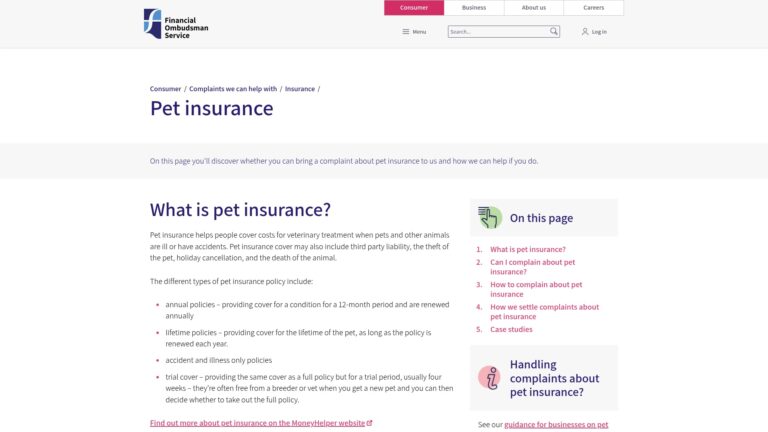
If your pet insurance claim has been turned down, you can challenge it, and it costs you nothing. Complain to the insurer first. If you are still unhappy after its final response, or it has not replied within eight weeks, take the complaint to the Financial Ombudsman Service (FOS). The service is free. You have six months from the date of the final response to do it.
Your best evidence is your vet’s clinical notes. Most disputes turn on what those notes say and when. This guide explains why claims get rejected, how the ombudsman decides pet insurance complaints and the deadlines that apply. We checked every rule here on the FOS and FCA websites on 16 October 2026.
Why Do UK Pet Insurers Reject Claims?
Most rejected claims come down to the policy wording: a pre-existing condition, a time limit that has run out, or treatment the policy excludes. The ombudsman lists these as common reasons owners bring pet insurance complaints, along with dental exclusions and claims declined because the insurer says a dog is aggressive.
Some complaints are about money rather than a refusal. The FOS also hears complaints about excess and co-payment deductions, sharp price rises and exclusions added to a policy after you bought it.
Pre-Existing Conditions And Bilateral Exclusions
A pre-existing condition is one your pet showed signs of before the policy started. Most policies exclude these. When an insurer refuses a claim on these grounds, the FOS checks two things. It asks whether this is the same condition, or a related one. It also asks whether you knew about it.
That second question matters. If the signs were there but you could not reasonably have known something was wrong, the FOS would not normally think it fair to refuse the claim. That applies especially if your vet told you there was no problem. Our guide to pre-existing conditions explains how insurers define them.
A bilateral condition affects both sides of the body, such as both knees or both eyes. Some insurers treat a problem on the second side as pre-existing if the first side was affected before. The FOS looks at the vet’s opinion and your pet’s history. It may side with you if a long time has passed and the vet examined the other side at the time and found nothing wrong.
The 14-Day Waiting Period Rule
Most policies do not cover an illness that first appears soon after the policy starts. The FOS says most exclude conditions that appear in the first 14 days. The period depends on your insurer.
Tesco, for example, excludes illness in the first 14 days and accidental injury in the first 3 days. Churchill excludes illness that arises in the first 10 days. ManyPets says there is no waiting period if you switch to it from another insurer. Check your own policy schedule for the dates that apply to you.
Routine Care And Dental Work Denials
Routine care is excluded by almost every policy. Budget for it yourself. Churchill, for example, does not pay for vaccinations or flea and worming treatment. Tesco’s wording excludes cleaning and descaling of teeth.
Dental illness claims often fail on a condition rather than an exclusion. Petplan covers dental conditions only if your pet has an annual dental check-up and any recommended treatment is done within six months. Churchill gives you three months. If the insurer refuses a dental claim, the FOS considers whether the term was clear and fair. It also looks at whether dental work was needed to treat something else, such as removing a tooth to treat a tumour. Our dental cover guide compares insurers’ rules.
How To Appeal A Rejected Pet Insurance Claim
You appeal in three steps: gather the vet evidence, complain to the insurer in writing, then go to the ombudsman if you need to. You cannot skip the insurer. The FOS will only look at your case once the insurer has sent a final response or eight weeks have passed.
Step 1: Contact Your Veterinary Surgeon For Medical Records
Ask your vet practice for a full copy of your pet’s clinical history, including notes, test results and X-ray reports. The FOS takes vet evidence into account, in particular clinical notes and written statements from vets.
If the dispute is about when a condition started, ask your vet to write a short letter giving their view. A clear statement from the vet who examined your pet carries more weight than your own account.
Step 2: Submit A Formal Internal Complaint To The Insurer
Write to the insurer and say clearly that you are making a complaint. Include:
- Your policy number and the claim reference.
- Why you think the decision is wrong, linked to the policy wording.
- Copies of the vet records and any letter from your vet.
Keep copies of everything you send and receive. The insurer then has up to eight weeks to send its final response.
Step 3: Escalate To The Financial Ombudsman Service
Go to the ombudsman if you disagree with the final response, or if eight weeks pass without one. You must do it within six months of the date on the final response. If that letter is dated 7 May, for example, your deadline is 7 November. Do not miss it.
If the FOS upholds your complaint, it can tell the insurer to pay all or part of the claim, with interest. It can also award compensation for distress or inconvenience.
Financial Ombudsman Service Data And Success Rates In 2026
The ombudsman does not publish a separate success rate for pet insurance. Its latest annual figures, for 2024/25, show it upheld 38% of the insurance complaints it resolved, against 34% across all financial products, according to its annual complaints data.
So roughly a third of insurance complaints succeed. Your own chances depend on the evidence. A clear vet record and a policy term that was not properly explained make the strongest case.
The most the ombudsman can award is £455,000 for complaints referred on or after 1 April 2026 about events since 1 April 2019. For events before that date, the limit is £205,000, according to the FOS compensation page. For comparison, the average pet insurance claim in 2024 was £685, according to the Association of British Insurers.
Consumer Rights And The Financial Conduct Authority Guidelines
The Financial Conduct Authority (FCA) sets the rules insurers must follow when they handle claims. Under ICOBS 8.1, an insurer must handle claims promptly and fairly. It must also give you reasonable guidance and must not unreasonably reject a claim. The FCA does not settle individual complaints. That is the ombudsman’s job. Our guide to the FCA Consumer Duty explains the rules insurers must follow.
The ombudsman also expects insurers to explain the important limits when you buy. It says telling you to read the policy document is not enough on its own. Pre-existing conditions should be mentioned at the point of sale and in the Insurance Product Information Document (IPID). Excesses and co-payments should be made clear too.
The FOS also sets an order for deductions. The insurer should take off the excess and co-payment before it applies the policy limit, not after. If an insurer wants to backdate an exclusion because you gave wrong information, it must meet the test in the Consumer Insurance (Disclosure and Representations) Act 2012. It has to show it asked you a clear question and that your answer changed what it would have done. Our guide to how the FCA regulates pet insurance covers the wider rules.
Summary Of Pet Insurance Appeal Timeframes
Three deadlines matter. The first is set by your policy. The other two are set by the complaint rules.
| Action | Deadline | Who |
|---|---|---|
| Submit the original claim | Set by your policy; check the claims section | You |
| Final response to your complaint | Up to 8 weeks from when the insurer receives it | Insurer |
| Refer the complaint to the ombudsman | Within 6 months of the date on the final response | You |
How To Prevent Future Pet Insurance Claim Rejections
Most rejections can be avoided by reading three parts of your policy before you need it: the exclusions, the conditions and the claims section. Then follow these habits:
- Answer every question honestly when you buy, including past vet visits.
- Keep up any check-ups your policy requires, such as an annual dental check.
- Send claims promptly, with the vet’s invoice and notes.
If your insurer tells you a condition will reach its time limit, note the date. Our guides to how to claim on pet insurance and the documents you need for a claim cover the process step by step.
Frequently Asked Questions About Pet Insurance Denials
Does a rejected claim affect future pet insurance premiums?
It depends on the insurer. Churchill, for example, lists your claims history as one of the factors that can affect your premium. Petplan says it will never charge you more for claiming. Ask your insurer whether a declined claim counts towards your claims history. Our guide to why pet insurance goes up covers the other reasons.
Can I switch insurers after a claim is rejected?
Yes, but a new insurer will usually exclude the condition. Anything your pet has already been treated for is likely to count as pre-existing with the new insurer. The FOS says it is unlikely a new lifetime policy will cover conditions your pet already has. Weigh that before you leave. Our guide to switching pet insurance explains the trade-off.
How long does the Financial Ombudsman Service take to make a decision?
There is no fixed timescale. The FOS says the time it takes varies with the nature of the complaint. Keep paying your premiums while you wait, so your pet stays covered for other problems.
Will my pet insurance pay out if my vet made a mistake?
Not until the record is put right. If the clinical notes contain an error, such as a wrong date for when symptoms started, ask your vet to correct the record in writing. Then send the correction to your insurer and ask it to look at the claim again. If it still refuses, follow the complaint steps above.
Ombudsman rules and limits change, usually each April. If you spot anything here that no longer matches the FOS or FCA websites, email [email protected]. For free help with your own complaint, you can also contact Citizens Advice.
Content is provided for informational purposes only and does not constitute financial advice. Always read the full policy terms before purchasing.