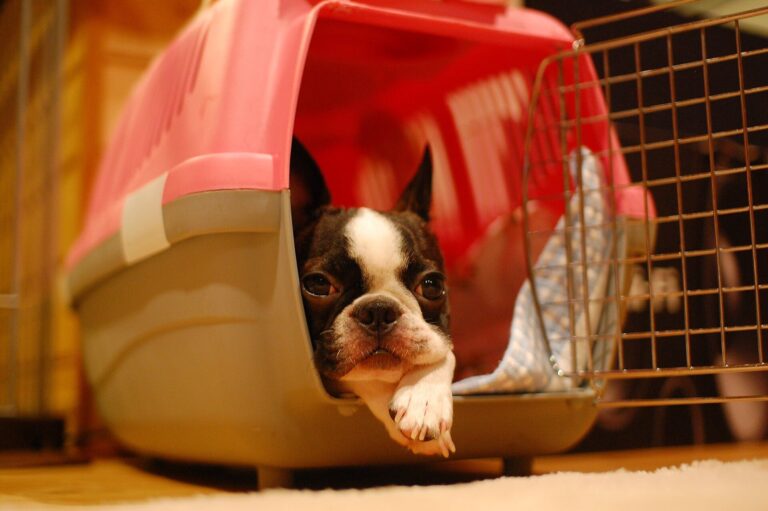
Learning how to crate train a puppy can help your new dog develop a positive association with a safe, comfortable resting space. When introduced gradually, a crate can become somewhere your puppy chooses to relax, sleep and enjoy quiet time.
However, crate training should never involve forcing your puppy inside, using the crate as punishment or leaving it confined for long periods.
UK animal welfare organisations, including the PDSA, Dogs Trust, RSPCA and Blue Cross, recommend introducing crates through gentle, reward-based training.
In this PetCoverHQ guide, we explain how to crate train a puppy in five practical steps, how to choose the right crate, how long your puppy can stay inside and what to consider during night-time training.
What Is Puppy Crate Training?
Puppy crate training involves teaching your dog to feel comfortable entering and resting inside a crate.
The aim is to create a secure, familiar space rather than a place of confinement or punishment.
The PDSA explains that crates can be useful for resting, travel, adapting to unfamiliar environments and short periods when direct supervision is not possible.
A crate may also become helpful if your dog needs restricted activity during recovery from an operation, under veterinary guidance.
However, not every dog enjoys a crate.
Some puppies may prefer a comfortable bed or a puppy-proofed area instead.
The most important consideration is whether your puppy feels relaxed and secure.
Benefits of Positive Crate Training
When introduced appropriately, crate training may help:
- Provide a quiet place for rest and sleep.
- Establish a predictable relaxation routine.
- Support safe management during short periods.
- Prepare your dog for certain travel situations.
- Familiarise your puppy with temporary confinement.
- Make some veterinary recovery arrangements easier.
These benefits depend on positive experiences and appropriate use.
A crate should not replace exercise, companionship, toilet breaks or interaction with your family.
How to Choose the Right Puppy Crate
Before learning how to crate train a puppy, choose a crate that suits your dog’s size and needs.
Your puppy should have enough room to stand, sit, turn around and lie down comfortably.
The Blue Cross and PDSA recommend considering the size your puppy will reach as an adult.
| Crate Feature | What to Look For |
|---|---|
| Crate type | A secure, well-ventilated design suitable for your puppy |
| Size | Enough space to stand, turn around and stretch out |
| Base | Stable, comfortable and easy to clean |
| Location | A family area away from draughts and direct heat |
| Bedding | Comfortable, suitable bedding |
| Water | Access to drinking water appropriate to the setup |
| Toys | Safe, age-appropriate chew items |
| Cover | Optional partial cover with adequate ventilation |
The Blue Cross suggests that wire crates may be more suitable than fabric crates for puppies that chew.
Fabric crates can be damaged by sharp puppy teeth.
If you are deciding between two sizes, a slightly larger crate is generally preferable to one that restricts movement.
Some larger crates have adjustable dividers that can be repositioned as a puppy grows.
Where Should You Put a Puppy Crate?
Place the crate somewhere your puppy can feel included in family life.
A quiet corner of a regularly used room may work well.
Avoid locations exposed to direct sunlight, excessive heat or cold draughts.
Keep the crate away from household hazards, trailing electrical cables and anything your puppy could pull through the bars.
If you use a crate cover, ensure adequate airflow and prevent your puppy from chewing or pulling the material inside.
How to Crate Train a Puppy in 5 Essential Steps
The following method combines guidance from the PDSA, RSPCA, Blue Cross and Dogs Trust.
When learning how to crate train a puppy, remember that progress depends on your puppy’s confidence.
Some puppies become comfortable quickly, while others need several days or longer at each stage.
Step 1: Introduce the Crate With the Door Open
Start by placing the crate in a comfortable area of your home.
Leave the door securely open so your puppy can enter and leave whenever it chooses.
Put a few small treats near the entrance.
If your puppy approaches confidently, place another treat just inside.
Gradually encourage exploration without forcing your puppy to enter.
Allow it to sniff the crate, investigate the bedding and leave freely.
You can also place a familiar toy inside.
Important: Never push your puppy into the crate or close the door before it feels comfortable.
The goal is to make the crate a place your puppy approaches willingly.
Step 2: Make the Crate a Rewarding Place
Once your puppy is happy entering the crate, begin creating positive associations.
Offer a suitable chew toy or a food-stuffed enrichment toy inside.
Make sure the item is appropriate for your puppy’s age, size and chewing habits.
You may also introduce meals near or inside the crate if your puppy is comfortable.
Allow your puppy to leave whenever it wants.
Do not call it back repeatedly or block the exit.
The PDSA and Dogs Trust recommend building confidence gradually through positive experiences.
At this stage, your puppy should begin associating the crate with relaxation and enjoyable activities.
Step 3: Close the Door for a Few Seconds
The next stage of how to crate train a puppy involves introducing brief periods with the door closed.
Wait until your puppy is settled inside with a suitable activity.
Gently close the door for a few seconds while remaining nearby.
Open it again before your puppy becomes distressed.
Reward calm behaviour and allow your puppy to leave.
Repeat this process over several short sessions.
Gradually increase the duration only when your puppy remains relaxed.
If your puppy begins whining, panting or trying to escape, the exercise may have progressed too quickly.
Return to an easier stage.
There is no need to rush towards longer periods of confinement.
Step 4: Help Your Puppy Relax While You Are Nearby
Once your puppy is comfortable with the door briefly closed, practise ordinary activities in the same room.
For example, you might sit nearby reading or working while your puppy rests with a safe chew.
Keep the atmosphere calm.
Avoid making every crate session an exciting event.
Gradually build the amount of time your puppy spends relaxing inside.
Continue observing its body language.
A puppy that lies down comfortably, rests or engages calmly with a toy may be coping well.
A puppy that repeatedly attempts to escape or becomes increasingly distressed needs a slower approach.
Outside structured training sessions, leave the crate door open whenever it is safe to do so.
This allows your puppy to choose the crate independently.
Step 5: Practise Leaving the Room Briefly
The final stage involves helping your puppy remain comfortable when you move out of sight.
Begin with very short absences.
You might stand up, walk a few steps away and return.
Once your puppy remains relaxed, briefly leave the room and come back.
The RSPCA suggests gradually building the time you are out of sight, potentially towards around 30 minutes as training progresses.
However, this is not a deadline or a target every puppy must reach.
Only increase the duration when your puppy remains comfortable.
If your puppy becomes distressed, shorten the absence and return to an easier exercise.
Successful crate training should build confidence, not teach your puppy to endure fear.
How Long Can a Puppy Stay in a Crate?
Understanding how to crate train a puppy also means knowing when confinement becomes excessive.
The PDSA and Blue Cross advise that dogs should not be kept in crates for more than three hours at a time.
This is an upper limit in their general guidance, not a recommended duration for young puppies.
A puppy that is still learning to use a crate may only be comfortable for a few seconds or minutes.
Young puppies also need frequent toilet breaks, regular movement, meals and companionship.
| Situation | Recommended Approach |
|---|---|
| First crate introduction | Door open; allow voluntary exploration |
| Early closed-door training | Begin with a few seconds |
| Puppy relaxing with you nearby | Increase duration gradually |
| Short periods out of sight | Build up only while your puppy remains comfortable |
| Extended daytime confinement | Avoid; provide appropriate care and supervision |
| Working away from home all day | Do not leave your puppy shut in a crate all day |
The RSPCA advises against leaving a dog confined in a crate throughout the working day.
If you must be away for longer periods, arrange suitable supervision and access to a safe, comfortable area.
Crate training is not a substitute for meeting your puppy’s physical and emotional needs.
How to Crate Train a Puppy at Night
Night-time crate training requires particular care because young puppies may feel unsettled in a new home.
They also have limited bladder control and may need overnight toilet breaks.
UK animal welfare organisations offer slightly different recommendations about overnight crate use.
Dogs Trust Advice
Dogs Trust advises against shutting a puppy inside a crate overnight.
It recommends staying close to your puppy initially and gradually helping it become comfortable sleeping independently.
Blue Cross Advice
The Blue Cross discusses placing a puppy’s bed or crate near you after its final toilet break.
It also advises against leaving a distressed puppy alone to cry.
PDSA Advice
The PDSA notes that young puppies may need toilet breaks during the night.
Owners should respond appropriately to their puppy’s needs rather than assuming all crying should be ignored.
Practical Night-Time Tips
Regardless of the sleeping arrangement you choose:
- Provide a comfortable sleeping space.
- Keep your puppy close during its first nights.
- Offer a toilet opportunity before bedtime.
- Respond calmly when your puppy wakes.
- Avoid exciting play during night-time toilet trips.
- Never force your puppy to remain confined when distressed.
Your puppy may need time to adjust to sleeping away from its littermates.
Comfort and reassurance are important during this transition.
Should You Let a Puppy Cry in Its Crate?
No. Leaving a frightened puppy to cry alone is not a recommended crate training method.
A puppy may vocalise because it needs the toilet, feels uncomfortable or is anxious.
First, check whether your puppy needs anything.
If it is distressed, provide reassurance and review the training stage.
The PDSA advises that comforting your puppy is appropriate.
Avoid assuming that ignoring prolonged crying will automatically teach independence.
If your puppy repeatedly becomes upset in the crate, reduce the difficulty of training.
You may need to return to open-door exercises and rebuild confidence.
Signs Your Puppy Is Not Comfortable in the Crate
Pay attention to your puppy’s behaviour throughout training.
The RSPCA identifies several warning signs that training may be progressing too quickly.
These include:
- Persistent whining or barking.
- Heavy panting unrelated to temperature or exercise.
- Cowering or trembling.
- Repeated attempts to escape.
- Aggressive behaviour when approached.
- Inability to settle.
- Increasing agitation.
If you notice these signs, stop increasing the duration of confinement.
Return to a stage where your puppy feels comfortable.
If distress continues, seek advice from your vet or a qualified reward-based behaviour professional.
Can Crate Training Help With Toilet Training?
A crate may support a broader toilet training routine, but it should never be used to force a puppy to hold its bladder.
Young puppies need frequent opportunities to relieve themselves.
Take your puppy outside after waking, eating, playing and at regular intervals throughout the day.
If your puppy has an accident in its crate, do not punish it.
Instead, review whether the crate is comfortable, whether toilet breaks are frequent enough and whether your puppy is spending too long inside.
Clean the area thoroughly with a suitable pet-safe product.
The goal is to establish healthy toileting habits, not to rely on confinement.
Common Puppy Crate Training Mistakes
Even owners who understand how to crate train a puppy can accidentally create negative experiences.
Using the Crate as Punishment
Never send your puppy into its crate as a punishment.
This can damage the positive association you are trying to build.
Closing the Door Too Early
Some puppies need several sessions before they feel comfortable entering voluntarily.
Move at your puppy’s pace.
Leaving Your Puppy Alone Too Long
Crates should not be used for extended confinement.
Young puppies need regular toilet breaks, exercise and interaction.
Ignoring Signs of Distress
Persistent crying, panting or escape attempts indicate that your puppy may be struggling.
Reduce the difficulty of training.
Using Unsafe Toys or Bedding
Choose items appropriate for your puppy’s size and chewing behaviour.
Remove damaged toys and avoid anything that presents a choking or entanglement risk.
Expecting Immediate Results
Crate training is a gradual process.
Some puppies adapt quickly, while others need more time.
Consistency and patience are more important than speed.
What If Your Puppy Refuses to Enter the Crate?
If your puppy avoids the crate, do not force it inside.
Begin by making the surrounding area comfortable.
Place treats near the entrance and reward your puppy for approaching.
Gradually move rewards closer to or just inside the crate.
Keep the door open throughout this stage.
You can also try changing the crate’s location or bedding.
If your puppy continues to avoid it, consider whether a different resting arrangement would be more suitable.
Not every dog needs to use a crate.
Crate Training and Separation Anxiety
Crate training should not be used as a treatment for separation anxiety without professional advice.
The PDSA cautions against using a crate to manage separation-related problems unless recommended by a vet or qualified behaviour professional.
Dogs experiencing separation anxiety may become more distressed when confined.
If your puppy panics when left alone, seek appropriate guidance rather than increasing crate time.
A safe resting area can be helpful, but emotional distress requires a suitable behaviour plan.
Supporting Your Puppy’s Training and Wellbeing
Crate training works best as part of a wider positive training routine.
Provide your puppy with appropriate exercise, play, socialisation, sleep and regular opportunities to explore.
If your puppy is also learning to control nipping and mouthing, our guide to how to stop a puppy biting offers practical advice.
It is also sensible to plan for your puppy’s healthcare needs.
Our guide to puppy insurance in the UK explains important considerations when comparing cover for a young dog.
At PetCoverHQ, we aim to help UK owners make informed decisions about puppy care, training and pet insurance.
Frequently Asked Questions About Puppy Crate Training
What is the best age to start crate training a puppy?
You can begin gentle crate introduction when your puppy arrives home, provided it feels settled enough to explore. Start with the door open and use positive rewards.
How long does it take to crate train a puppy?
There is no fixed timetable. Some puppies become comfortable relatively quickly, while others need several weeks or longer. Progress depends on the individual puppy.
Is crate training cruel?
Crate training is not inherently cruel when the crate is introduced positively and used appropriately. However, forcing a dog inside, using the crate as punishment or confining it excessively can harm welfare.
How long can a puppy stay in a crate?
The PDSA and Blue Cross advise a maximum of three hours at a time for dogs in general. Young puppies and those new to crate training usually need much shorter periods.
Should I close my puppy’s crate at night?
UK charities provide different guidance. Dogs Trust advises against shutting puppies in crates overnight, while other guidance discusses crates as sleeping spaces. Prioritise your puppy’s comfort, toilet needs and welfare.
Should I let my puppy cry in the crate?
No. Check whether your puppy needs the toilet, comfort or a break. Persistent distress suggests training is progressing too quickly.
Can I use a crate while I am at work?
A crate should not be used to confine your puppy throughout the working day. Arrange suitable care, supervision and toilet opportunities.
Conclusion
Learning how to crate train a puppy requires patience, consistency and positive reinforcement.
Start by allowing your puppy to explore the crate voluntarily. Gradually introduce rewards, brief closed-door sessions and short periods when you move away.
Never use the crate as punishment, and avoid leaving your puppy confined for excessive periods.
Night-time arrangements should prioritise comfort, reassurance and appropriate toilet breaks.
With gentle training, a crate may become a useful resting space for your puppy. However, if your dog remains uncomfortable, alternative sleeping and management arrangements may be more suitable.
For more puppy care, training and UK pet insurance information, explore PetCoverHQ.
This article provides general puppy care information and does not replace advice from a qualified veterinary or animal behaviour professional.