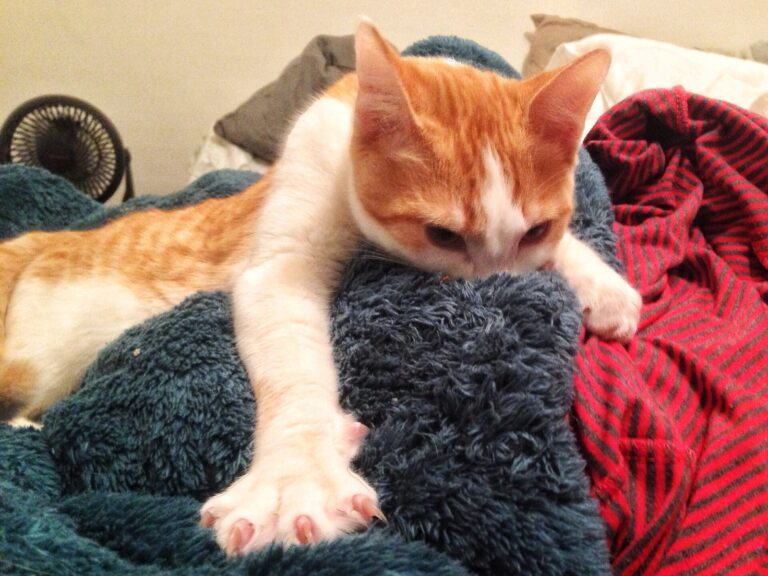
Why do cats knead? If you have ever watched your cat rhythmically push its paws into a soft blanket, cushion or your lap, you have witnessed one of the most familiar behaviours in domestic cats.
Often called “making biscuits”, kneading is a natural movement that begins when cats are kittens. Young kittens press their paws against their mother’s belly while nursing, helping stimulate milk flow.
Many cats continue this behaviour into adulthood, particularly when they feel comfortable or relaxed.
However, scientists have not established one definitive explanation for why adult cats knead.
In this PetCoverHQ guide, we explore seven possible reasons behind cat kneading, why some cats purr or dribble while doing it, and what you can do when those sharp claws become uncomfortable.
What Is Cat Kneading?
Cat kneading is a rhythmic movement in which a cat alternately pushes its front paws against a soft surface.
The movement resembles someone kneading bread dough, which explains the popular nickname “making biscuits”.
According to the Blue Cross, kneading begins during kittenhood.
Newborn kittens instinctively press their paws against their mother’s abdomen while feeding.
This movement helps stimulate the flow of milk.
As kittens grow older, some stop kneading regularly, while others continue the behaviour throughout adulthood.
Adult cats may knead:
- Soft blankets and cushions.
- Their owner’s lap or chest.
- Comfortable beds.
- Clothing and jumpers.
- Other soft household surfaces.
Kneading is generally considered normal feline behaviour.
Why Do Cats Knead? 7 Possible Explanations
The question why do cats knead has interested cat owners and animal behaviour experts for years.
Although the nursing instinct is well established, several explanations for adult kneading remain theories rather than proven causes.
1. Kneading Begins as a Kitten Nursing Instinct
The clearest explanation for kneading comes from early kitten development.
While nursing, kittens push their paws against their mother’s belly to stimulate milk production.
This movement becomes associated with feeding, warmth and close contact.
Some cats retain the behaviour after weaning.
International Cat Care describes kneading as a behaviour that may continue into adulthood, particularly when cats interact with soft objects or trusted people.
Not every adult cat kneads regularly.
Some rarely show the behaviour, while others continue making biscuits throughout their lives.
Both patterns can be normal.
2. Your Cat May Feel Safe and Comfortable
One common explanation for why cats knead is that the behaviour is associated with feelings of comfort and security.
Kittens experience warmth and safety while feeding from their mother.
Adult cats may repeat the familiar movement when they feel relaxed.
For example, your cat might begin kneading while resting beside you on the sofa.
You may notice relaxed body language, slow blinking or gentle purring at the same time.
These behaviours can suggest that your cat feels comfortable.
However, kneading alone cannot tell you exactly what your cat is feeling.
Consider its overall body language and the situation.
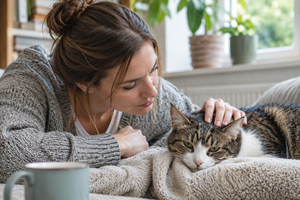
3. Kneading Can Be Associated With Affection
Many owners wonder why their cats knead directly on their laps.
A possible explanation is that the cat associates its owner with comfort and security.
Cats may knead while settling down for a cuddle or resting against someone they trust.
The Blue Cross describes kneading as a behaviour commonly associated with contentment.
Some cats knead more vigorously when they are especially relaxed.
Unfortunately, that can make an affectionate moment uncomfortable for the person underneath.
If your cat kneads your lap, try placing a thick blanket between its paws and your skin.
There is no need to punish your cat for expressing a natural behaviour.
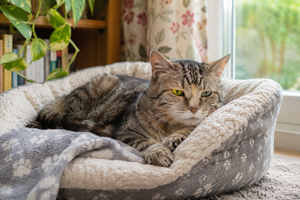
4. Cats May Knead to Prepare a Comfortable Sleeping Spot
Another explanation for why cats knead is that the movement may help them prepare a resting place.
Some cats knead blankets or cushions immediately before lying down.
This has led to the theory that kneading may be related to ancestral nesting behaviour.
Wild feline ancestors may have pressed down grass or other vegetation before resting.
However, Cats Protection notes that the exact purpose of kneading in adult cats remains uncertain.
The nesting explanation is therefore best understood as a possible theory rather than a confirmed scientific fact.
5. Soft Textures May Encourage Kneading
Many cats show a clear preference for kneading soft materials.
You may notice your cat choosing:
- Fleece blankets.
- Fluffy cushions.
- Soft jumpers.
- Comfortable bedding.
- Upholstered furniture.
These textures may resemble the soft surfaces associated with early nursing experiences.
International Cat Care notes that some adult cats regularly knead soft cushions or blankets.
The behaviour may also occur when a cat is preparing to rest.
If your cat repeatedly kneads one particular blanket, it may simply be a preferred comfortable surface.
6. Kneading May Be Part of a Relaxation Routine
Some cats knead as part of a familiar sequence of behaviours before sleeping.
For example, your cat might:
- Jump onto its favourite blanket.
- Circle around a few times.
- Begin kneading with its front paws.
- Purr or settle into a comfortable position.
- Curl up and fall asleep.
This pattern suggests that kneading can form part of a relaxation routine.
Cats Protection discusses the possibility that kneading is associated with positive emotional experiences.
However, researchers have not fully established the neurological processes involved.
It is reasonable to describe kneading as a behaviour often associated with relaxation, rather than claiming it always produces a specific chemical response.
7. Kneading May Continue Because It Is a Familiar Habit
Sometimes, the simplest explanation for why cats knead is that the behaviour has continued from kittenhood.
Not every feline behaviour has an obvious purpose in adulthood.
Kneading begins with a practical function during nursing, but adult cats no longer need to stimulate milk flow.
Cats Protection explains that the purpose of adult kneading is not completely understood.
Some cats may continue the movement because it is familiar and associated with comfortable experiences.
The frequency of kneading can vary considerably between individual cats.
What Does Your Cat’s Kneading Mean?
The following table summarises common interpretations of cat kneading.
| Behaviour | Possible Explanation | Typical Situation |
|---|---|---|
| Kneading a blanket | Familiar kitten behaviour or comfort | Before resting |
| Kneading your lap | Comfort and security | During a cuddle |
| Kneading while purring | Relaxation or contentment | While settling down |
| Kneading before sleep | Possible nesting behaviour | On a bed or cushion |
| Kneading with claws extended | Normal paw movement | On soft surfaces |
| Kneading while dribbling | Possible association with nursing | During relaxed kneading |
These interpretations are general possibilities.
A cat’s body language, environment and individual habits are important when assessing behaviour.
Why Do Cats Knead and Purr at the Same Time?
Cats sometimes purr while kneading because both behaviours can occur during comfortable, relaxed moments.
A cat may climb onto your lap, begin pushing its paws against your clothing and purr softly.
This combination is often associated with contentment.
However, purring does not always indicate happiness.
Cats may also purr in other situations, including when stressed or unwell.
If your cat appears relaxed, kneading and purring together are usually nothing to worry about.
Our guide to why cats purr explores the different meanings of feline purring.
Why Do Cats Dribble While Kneading?
Some cats produce saliva while kneading.
The Blue Cross and International Cat Care describe dribbling as a behaviour that can accompany kneading.
One proposed explanation is that kneading activates associations with nursing during kittenhood.
For some cats, this may occur alongside purring and relaxed body language.
However, the precise explanation has not been conclusively established.
When Is Dribbling a Concern?
Occasional mild dribbling during a familiar kneading routine may be normal for an individual cat.
However, new, excessive or persistent drooling can indicate a medical problem.
Possible concerns include dental disease, oral pain, nausea or exposure to harmful substances.
Contact your vet if your cat suddenly begins drooling more than usual, particularly if it also shows:
- Difficulty eating.
- Bad breath.
- Pawing at its mouth.
- Reduced appetite.
- Vomiting.
- Unusual behaviour.
Do not assume that all drooling is caused by happiness or kneading.
Why Does My Cat Knead Me but Not Other People?
Cats may behave differently around different household members.
Your cat might prefer sitting on your lap because it finds your position, clothing or routine particularly comfortable.
It may also have developed a familiar habit of resting with you.
Although kneading can be associated with trust and security, it does not necessarily mean your cat loves one person more than another.
Cats express comfort and attachment in different ways.
Some enjoy physical contact, while others prefer sitting nearby without being touched.
The important thing is to respect your cat’s individual preferences.
Why Do Cats Knead Blankets?
Blankets provide soft surfaces that many cats enjoy pressing their paws against.
Kneading may be associated with early nursing experiences, relaxation or preparation for sleep.
Some cats repeatedly return to the same blanket.
This is generally normal if the cat appears comfortable and the behaviour does not interfere with everyday activities.
If your cat also sucks or chews fabric, supervise it carefully.
Swallowing pieces of fabric can cause serious digestive problems.
Seek veterinary advice if your cat regularly eats non-food materials.
What Should You Do If Cat Kneading Hurts?
Although kneading is usually harmless, a cat’s claws can make the experience painful.
The Blue Cross recommends allowing cats to express this natural behaviour rather than punishing them.
Use a Thick Blanket
Place a folded blanket across your lap before your cat settles down.
This creates a protective barrier between its claws and your skin.
Offer a Comfortable Alternative
If your cat repeatedly kneads your bare legs, encourage it to settle on a soft cushion or blanket beside you.
Reward calm behaviour without forcing it to move.
Check Your Cat’s Claws
Overgrown claws may cause discomfort or increase accidental scratches.
Ask your vet or veterinary nurse whether trimming is appropriate.
Never cut a cat’s claws without understanding how to avoid the sensitive quick.
Avoid Punishment
Do not shout, hit or spray water at your cat for kneading.
International Cat Care cautions that punishment may damage the relationship between a cat and its owner.
Instead, gently adjust your position or provide a protective surface.
Is Cat Kneading Ever a Sign of Stress?
Kneading is commonly associated with comfort, but behaviour should always be interpreted in context.
Some cats may repeat familiar behaviours when seeking reassurance.
However, kneading alone is not enough to diagnose anxiety.
Look for other changes, such as:
- Hiding more frequently.
- Reduced appetite.
- Changes in toileting habits.
- Excessive grooming.
- Increased vocalisation.
- Avoiding familiar people.
- Sudden changes in activity.
If your cat begins kneading much more frequently and also shows other concerning symptoms, contact your vet.
A qualified feline behaviour professional may also help if environmental stress is suspected.
Should You Stop Your Cat From Kneading?
In most situations, there is no reason to stop a cat from kneading.
It is a normal behaviour that may help your cat settle comfortably.
Trying to eliminate it can create unnecessary frustration or anxiety.
Instead, manage any practical problems.
Use blankets to protect your skin, provide soft resting areas and keep claws in good condition.
If kneading is accompanied by unusual behaviour or possible signs of illness, seek veterinary advice.
For new kitten owners, establishing good care routines early is also important.
Our guide to kitten insurance in the UK explains considerations when comparing cover for a young cat.
Frequently Asked Questions About Cat Kneading
Why do cats knead their owners?
Cats may knead their owners because they associate close contact with comfort and security. The behaviour originates during kittenhood, when kittens knead their mothers while nursing.
Why do cats make biscuits?
Making biscuits is another name for kneading. The alternating paw movement resembles someone kneading bread dough.
Why do cats knead blankets?
Soft blankets may encourage a familiar behaviour associated with comfort, early nursing experiences or preparing to rest.
Why do cats knead and purr?
Kneading and purring can occur together when a cat feels relaxed. However, purring has several possible meanings, so consider the cat’s overall behaviour.
Why does my cat drool when kneading?
Some cats dribble while kneading, possibly because the behaviour is associated with nursing experiences. Sudden or excessive drooling should be assessed by a vet.
Does kneading mean my cat loves me?
Kneading on your lap may suggest that your cat feels safe and comfortable with you. However, it is not a definitive measure of affection.
Should I stop my cat kneading?
Usually not. Kneading is normal feline behaviour. If the claws hurt, use a thick blanket or offer a comfortable alternative.
Conclusion
Why do cats knead? The behaviour begins during kittenhood, when kittens press their paws against their mother’s belly to stimulate milk flow.
Many cats continue kneading as adults, particularly when resting on soft blankets, cushions or trusted people.
Although kneading is often associated with comfort and relaxation, scientists have not fully established why adult cats retain the behaviour.
If your cat kneads your lap, enjoy the moment while protecting your skin with a blanket.
For more practical cat behaviour, health and UK pet insurance information, explore PetCoverHQ.
This article provides general cat care information and does not replace advice from a qualified veterinary professional.